
What is AI 402 Pay?
AI 402 Pay, technically referred to as the x402 protocol, is an open standard that enables machine-to-machine transactions by reviving the HTTP 402 "Payment Required" status code. Originally defined in RFC 2068 in 1996, this status code was historically unused because web browsers and servers lacked a standardized mechanism for handling digital currency. The x402 protocol solves this gap, allowing AI agents to autonomously verify and execute cryptocurrency payments for digital services.
Unlike traditional subscription models, x402 facilitates a pay-per-use architecture. The protocol enables micropayments as small as $0.01, making it economically viable for AI agents to purchase individual tokens, API calls, or data points without the overhead of credit card processing fees or recurring billing infrastructure. This efficiency is critical for the emerging agent economy, where automated systems require seamless, low-friction payment rails to operate at scale.
The implementation relies on a facilitator service that handles the verification and submission of transactions. By leveraging account abstraction standards like EIP-7702, the facilitator allows agents to submit gasless transactions using their own server wallets. This architecture ensures that the payment logic remains decentralized and transparent, adhering to the original intent of the HTTP specification while adapting it for the needs of automated software agents.
How x402 Automates Invoice Processing
The x402 protocol transforms the Hypertext Transfer Protocol (HTTP) into a payment rail, allowing AI agents to settle debts without human intervention. By reviving the HTTP 402 status code—originally intended for payments but largely ignored—the system enables machine-to-machine invoicing at the network level. When an AI agent requests a service, the provider responds with a 402 status and a payment request. The agent’s wallet then executes the transaction, unlocking the requested resource. This mechanism is the foundation of AI 402 Pay, turning standard API calls into self-executing commercial agreements.
The automation relies on a strict sequence of cryptographic and network events. Below is the operational flow of an x402 transaction.

The process begins when a buyer AI agent sends an HTTP GET request to a service provider’s endpoint. The request contains standard headers and identifies the specific resource or computation the agent requires. At this stage, no payment has occurred, and the provider recognizes the agent by its public key or wallet address.
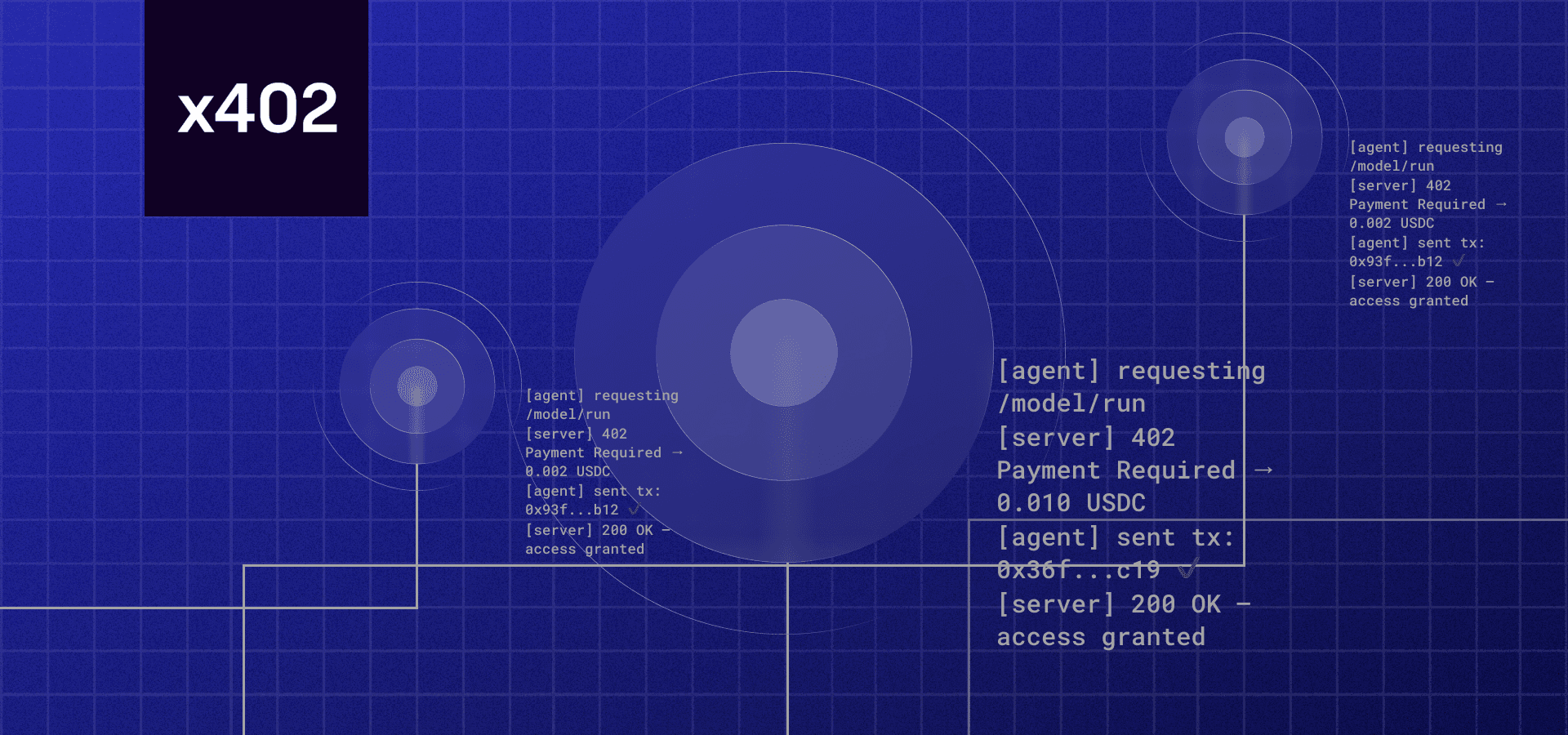
Instead of returning the data immediately, the provider responds with an HTTP 402 status code. The response body contains a structured payment request, typically formatted as JSON. This payload includes the amount due, the accepted cryptocurrency or stablecoin, the destination wallet address, and a unique transaction ID. This step effectively acts as a digital invoice generated in real-time.
The buyer AI agent parses the 402 response and constructs a transaction. Using its connected wallet, the agent signs the payment request and broadcasts it to the blockchain. This step is fully autonomous; the agent’s internal logic verifies the price and balance before signing. No human approval is required for transactions within the agent’s predefined budget limits.
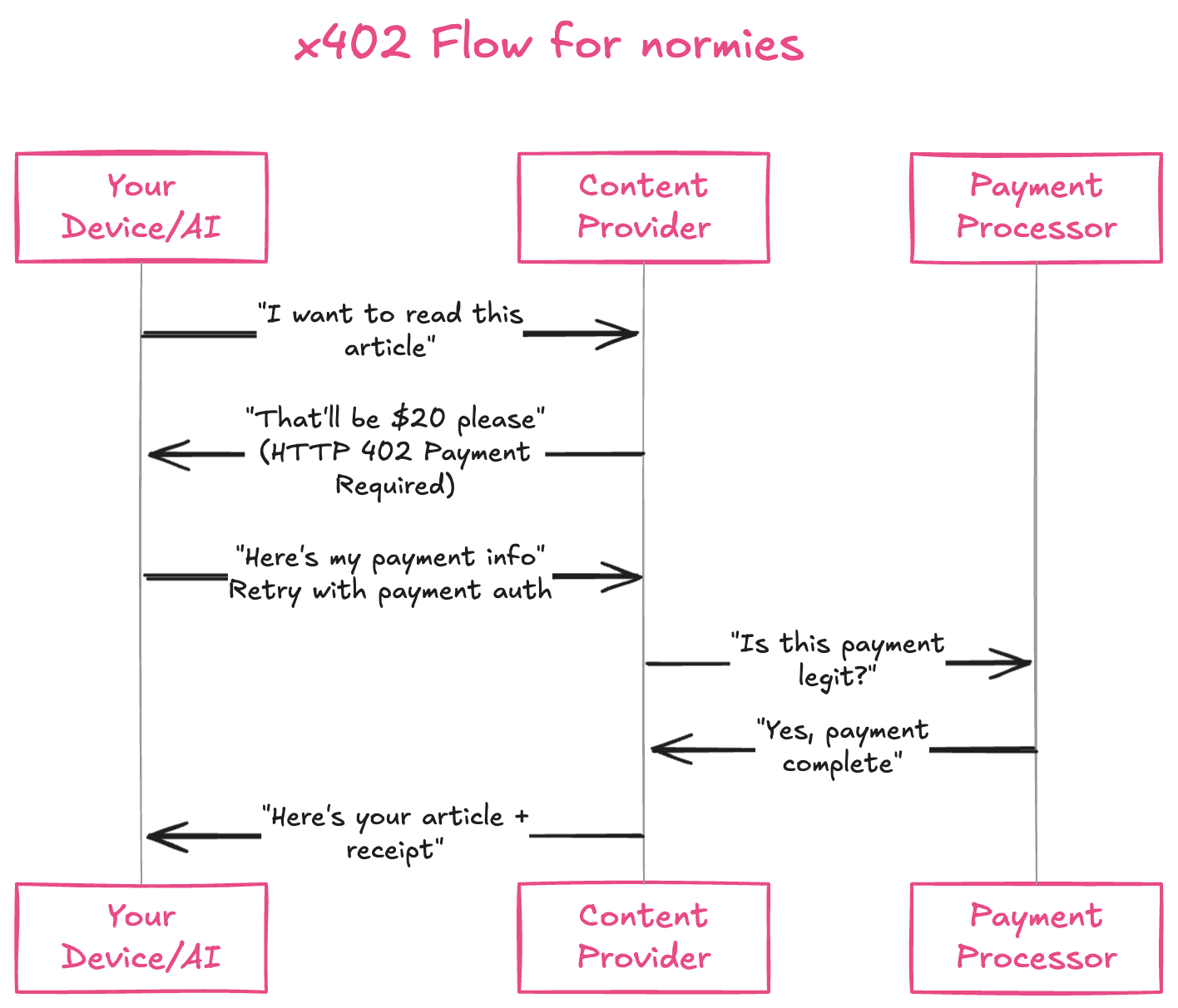
Once the blockchain confirms the transaction, the provider’s backend detects the payment. The system then serves the originally requested data or activates the service. The entire cycle—from request to data delivery—occurs in seconds, enabling high-frequency micropayments that are impossible with traditional banking rails.
This automated flow eliminates the friction of invoicing, reconciliation, and manual payment processing. By embedding payment logic into the HTTP response, AI 402 Pay ensures that services are only delivered when compensation is secured. This creates a trustless environment where AI agents can operate as independent economic actors, negotiating and settling debts at machine speed.
AI 402 Pay vs traditional AP systems
AI 402 Pay replaces manual invoice routing with machine-readable HTTP 402 responses. When an AI agent requests a service, the response includes a payment requirement. The agent pays via a facilitator using EIP-7702 gasless transactions, and the service is delivered immediately. Traditional accounts payable (AP) systems rely on human verification, email attachments, and bank transfers that take days to settle.
The x402 protocol treats payment as a technical handshake rather than a financial afterthought. This allows agents to pay for exactly what they use, prepaid credits just recreate the subscription model with extra steps. In contrast, legacy AP software manages static vendor lists and approval workflows that cannot adapt to dynamic, real-time service requests.
| Feature | AI 402 Pay (x402) | Traditional AP Systems |
|---|---|---|
| Initiation | Agent triggers payment via HTTP 402 response | Human uploads invoice to portal |
| Verification | Cryptographic signature validation | Manual data entry and matching |
| Settlement Time | Near-instant (blockchain confirmation) | 3–10 business days |
| Human Intervention | Zero (fully autonomous) | High (approvals, exceptions) |
| Scalability | Scales with API requests | Scales with staff headcount |
x402 facilitates this by using a thirdweb facilitator that handles verifying and submitting payments. This leverages your own server wallet to submit transactions gaslessly. The thirdweb facilitator is compatible with any x402 backend and middleware libraries like x402-hono and x402-next. Traditional AP systems require dedicated staff to reconcile these payments, creating a bottleneck that AI agents cannot bypass.
The core difference lies in intent. With x402, however, an AI agent can directly request and pay for external services on demand, allowing it to operate dynamically. Legacy systems are designed for static, predictable billing cycles. AI 402 Pay is built for the machine economy, where services are consumed in micro-fragments and require instant, programmable settlement.
Security and compliance in AI payments
The shift to machine-to-machine invoicing via AI 402 Pay introduces distinct security challenges. Unlike human-driven transactions, AI agents operate autonomously, requiring robust verification layers to prevent fraud and ensure compliance. The x402 protocol addresses these risks through cryptographic signatures and standardized HTTP status codes, ensuring that payments are both verifiable and immutable.
Fraud detection and shared responsibility
Security in AI 402 Pay is a shared responsibility. While platforms integrate advanced fraud detection and encryption, users must maintain strong wallet security practices. The protocol relies on the integrity of the underlying blockchain, but the safety of the agent's private keys remains the user's primary duty. A compromised key can lead to unauthorized machine-to-machine transactions, making key management critical.
The role of the facilitator
To streamline the verification process, the x402 facilitator acts as a middleware service. It handles the verification and submission of payments, leveraging EIP-7702 to execute transactions gaslessly using the user's server wallet. This third-party facilitator is compatible with various x402 backend and middleware libraries, such as x402-hono and x402-next, ensuring a standardized approach to compliance and transaction integrity across different AI agent ecosystems.
Key Questions About AI 402 Pay
Is AI 402 Pay safe?
Security in AI 402 Pay relies on the underlying cryptographic standards of the blockchain and the specific implementation of the x402 protocol. As an open standard, it leverages existing blockchain security models rather than introducing new, unproven vulnerabilities. However, safety is a shared responsibility. While the protocol ensures that payments are cryptographically verifiable, developers must implement robust fraud detection, encryption, and buyer protection layers on top of the base layer. Users should actively participate by using strong security practices, such as securing their server wallets and verifying the integrity of the AI agents they interact with.
What is an x402 facilitator?
An x402 facilitator is a service that handles the verification and submission of x402 payments on behalf of AI agents. It allows agents to use their own server wallet while leveraging EIP-7702 to submit transactions gaslessly. This abstraction simplifies the payment process for machine-to-machine interactions, as the facilitator manages the complex signing and broadcasting of transactions. The thirdweb facilitator is a common example, compatible with any x402 backend and middleware libraries like x402-hono or x402-next, ensuring that the payment flow remains seamless for the AI agent while maintaining security on the blockchain.
How does AI 402 Pay differ from traditional payment processors?
Traditional payment processors like Stripe act as centralized intermediaries that manage the entire transaction lifecycle, including fraud checks and settlement. AI 402 Pay, built on the x402 protocol, shifts this model toward machine-to-machine interactions. Instead of a human-driven checkout, an AI agent directly requests a resource and pays for it using a cryptographic proof embedded in the HTTP response. This reduces friction for automated workflows and eliminates the need for traditional merchant accounts, though it requires the AI agent to manage its own wallet and transaction fees.
Can AI agents handle recurring payments with AI 402 Pay?
Yes, AI 402 Pay supports recurring billing through automated agent workflows. An AI agent can be programmed to trigger payments at specific intervals or based on usage metrics, such as API calls or data consumption. The x402 protocol facilitates this by allowing the agent to generate and submit payment proofs automatically. This is particularly useful for services like cloud computing or data feeds, where usage is variable and continuous. The facilitator service helps manage the gas costs and transaction submission, making recurring payments feasible for autonomous agents without human intervention.
No comments yet. Be the first to share your thoughts!