
What is AI 402 Pay
AI 402 Pay, often referred to as the x402 protocol, is a technical framework that revives the dormant HTTP 402 status code to facilitate automated cryptocurrency transactions. Originally defined in 1997 as a theoretical standard for digital payments, HTTP 402 was never widely adopted in traditional web development. Today, it serves as the foundation for AI agents to autonomously pay for API access and digital content without human intervention.
The protocol operates by embedding payment logic directly into the response headers of an API call. When an AI agent requests data, the server responds with a 402 status code and a smart contract address. The agent must then execute a micropayment—typically in stablecoins or native blockchain tokens—to access the requested resource. This mechanism replaces traditional subscription models or manual invoice processing with instant, permissionless transactions.
For developers and business strategists, the shift to AI 402 Pay represents a move toward granular monetization. Instead of paying for bulk access or monthly seats, AI agents pay only for the specific computations or data points they consume. This aligns costs directly with usage, enabling new business models for high-frequency, low-value digital interactions that were previously economically unviable due to transaction fees.
How the x402 Protocol Works
The x402 protocol transforms standard HTTP interactions into payment-ready transactions. Instead of relying on traditional credit card gateways or complex wallet integrations for every small interaction, the protocol uses the existing HTTP 402 "Payment Required" status code. This allows AI agents and servers to negotiate micropayments natively over the web.
The workflow follows a strict sequence of request, response, and execution. Below is the step-by-step technical flow of an x402 transaction.
The AI agent sends a standard HTTP GET or POST request to the content provider's API endpoint. At this stage, the request is treated like any other web query, but it includes metadata indicating the agent's capability to pay via crypto or fiat-supported networks.
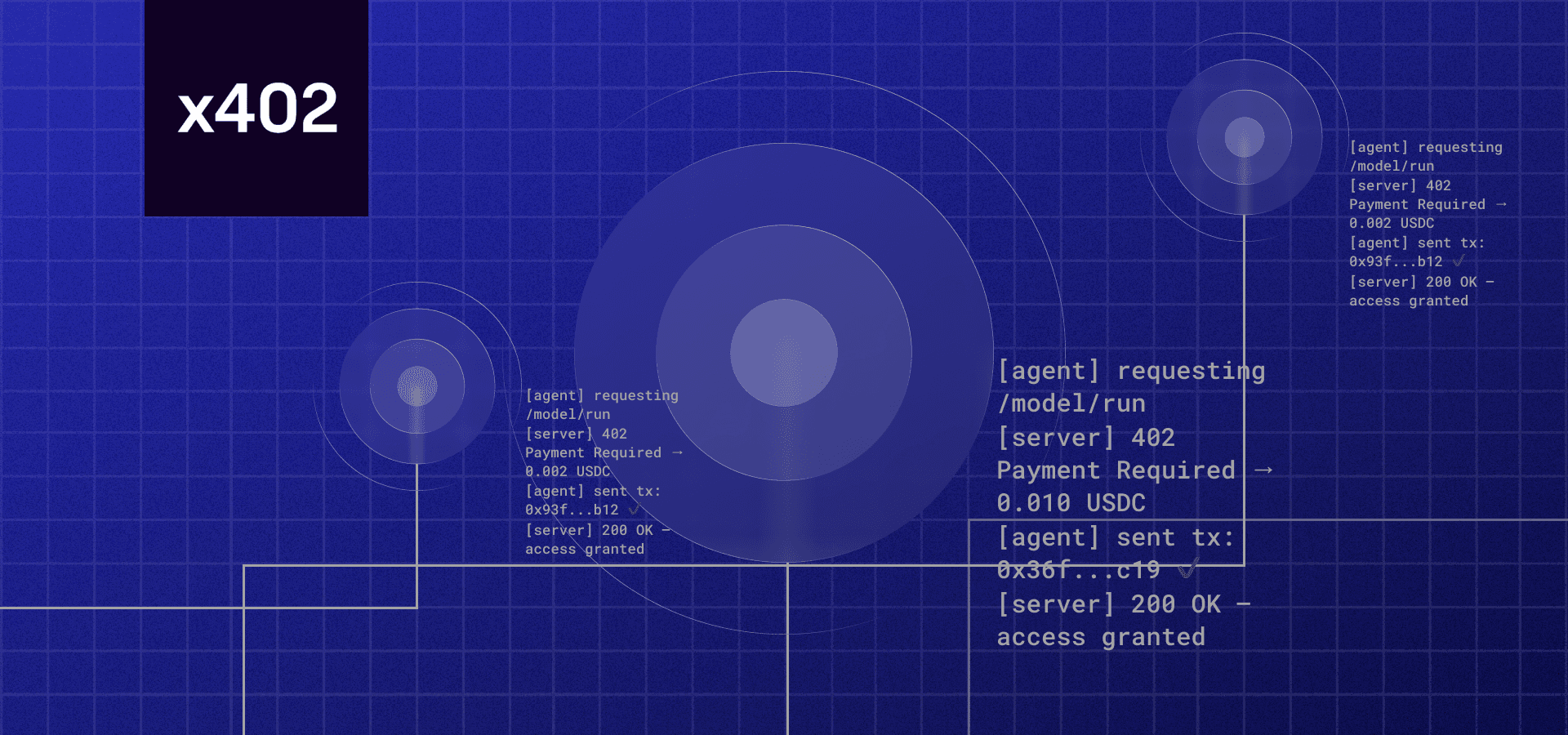
The server recognizes the request requires payment and returns an HTTP 402 status code. Crucially, the response body contains a payment instruction. This instruction details the amount, the required currency (e.g., USDC, ETH), and the destination wallet address or smart contract interface.
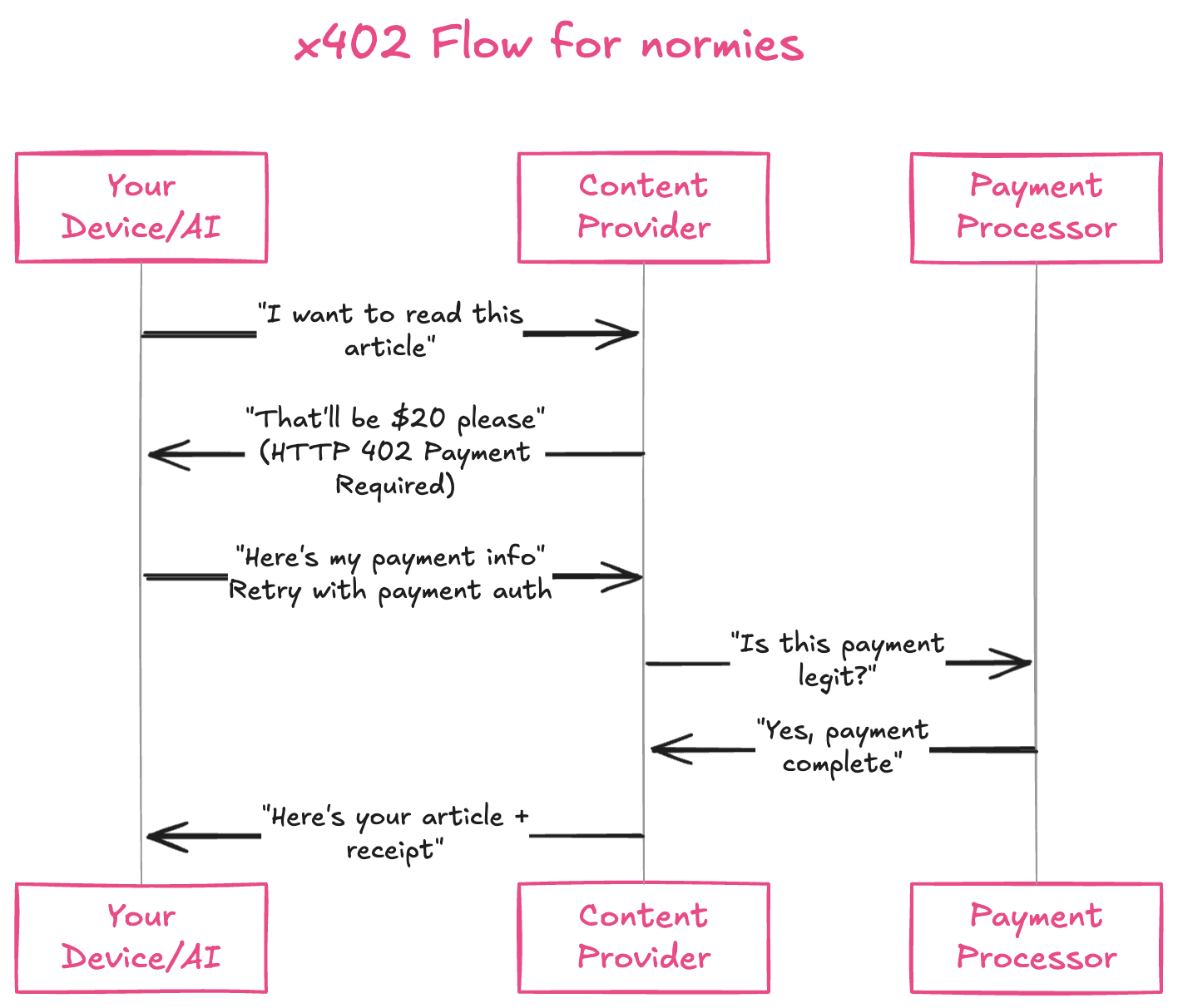
The agent's local wallet or payment module receives the 402 instruction. It constructs a transaction on the specified blockchain network to send the exact micropayment amount to the server's address. This step leverages smart contracts to ensure atomicity, meaning the payment is either fully confirmed or reverted instantly.
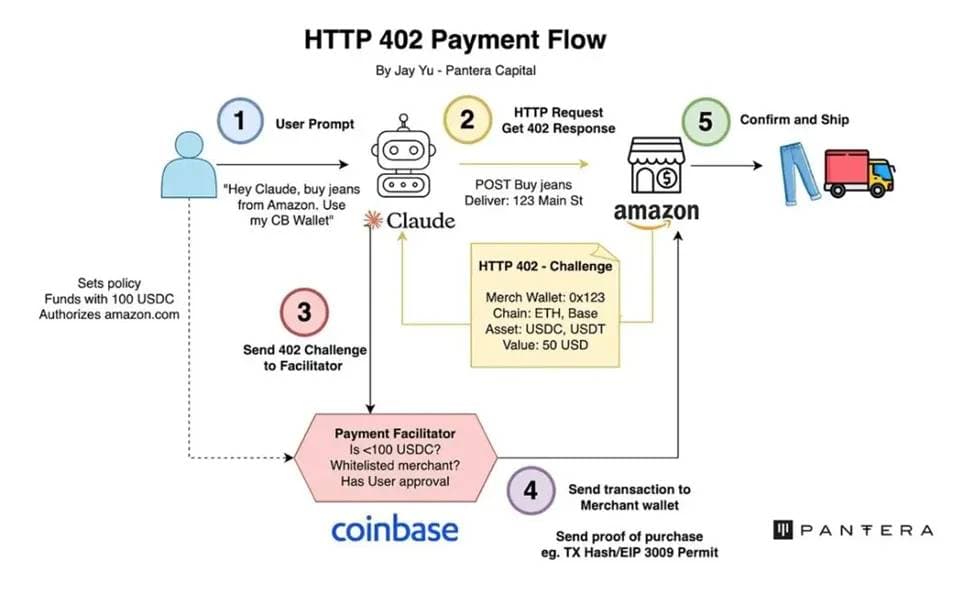
Once the blockchain confirms the transaction, the server verifies the payment hash. Upon successful validation, the server reprocesses the original request, this time returning the HTTP 200 OK status along with the requested content. The data is now accessible for the agent to process.
This flow ensures that payment happens before data delivery, eliminating the need for pre-funded accounts or subscription management for one-off queries. By embedding payment logic directly into the HTTP response, x402 creates a seamless bridge between web infrastructure and blockchain economics.
Why Agents Prefer Micropayments
AI agents operate at a scale and velocity that traditional subscription models cannot support. When an agent autonomously processes thousands of requests per hour, a flat monthly fee creates a misalignment between cost and actual usage. Micropayments solve this by charging strictly per inference, ensuring that the agent only pays for the compute it actually consumes.
This shift transforms AI agents from passive consumers into active economic actors. By using smart contracts to settle transactions instantly, the x402 protocol allows agents to negotiate and pay for resources without human intervention. As noted in industry analysis, prepaid credits often just recreate the subscription model with extra steps, whereas true micropayments align cost with utility.
For developers and strategists, this means the economic viability of agentic workflows depends on low-latency, low-friction payment rails. Crypto-based micropayments provide the necessary infrastructure for these high-frequency transactions, enabling a granular economy where value is exchanged precisely at the moment of service delivery.
Implementing x402 for Developers
Integrating x402 allows your application to accept automated cryptocurrency payments from AI agents. This protocol uses standard HTTP responses to signal when a request requires payment, enabling seamless micropayments without complex manual wallet interactions. Developers can choose between building custom smart contracts or using a payment facilitator like PayAI to handle the transaction layer.
Facilitators and Integration
Using a facilitator such as PayAI simplifies the process by managing wallet infrastructure and supporting multiple blockchain networks through a single integration. This approach removes the need for agents to manage private keys directly, reducing security risks and development overhead. Custom smart contracts offer more control but require significant engineering effort to handle gas fees, transaction retries, and cross-chain compatibility.
Cost Estimation
Before deploying, calculate your expected revenue based on request volume and pricing models. Use the tool below to estimate daily costs or revenue projections based on your traffic.
Protocol Comparison
| Feature | Custom Smart Contracts | PayAI Facilitator |
|---|---|---|
| Integration Effort | High (Custom code required) | Low (One-time SDK integration) |
| Supported Chains | Limited to your deployment | Every major chain |
| Wallet Management | Developer responsibility | Handled by facilitator |
| API Keys | Required for each chain | None required |
Custom solutions are best for high-volume, specialized use cases where you need full control over transaction logic. For most developers, a facilitator provides the fastest path to monetizing AI services with minimal maintenance.
Estimate Your AI Inference Costs
The x402 protocol shifts AI infrastructure from fixed subscription fees to a utility-based model. Agents pay only for the specific inference requests they execute, turning computing power into a precise, billable commodity. This structure allows developers to align operational expenses directly with actual usage, eliminating the waste associated with idle capacity.
Use the calculator below to project your monthly burn rate. By inputting your expected request volume and the per-call fee set by the service provider, you can determine the total cost in your chosen cryptocurrency. This helps in budgeting for high-frequency agent interactions or scaling up computational resources without unexpected financial spikes.
Common Questions About x402
Developers and strategists often ask how the x402 protocol handles the technical realities of machine-to-machine transactions. The answers focus on protocol design rather than market speculation.
No comments yet. Be the first to share your thoughts!