
What is AI 402 Pay in 2026
AI 402 Pay refers to the implementation of the x402 protocol, which revives the HTTP 402 "Payment Required" status code to enable machine-to-machine transactions. In the agentic economy of 2026, AI agents need a way to pay for data, compute, and API access without human intervention. The x402 protocol provides this by turning HTTP responses into machine-readable payment requests, allowing agents to settle micro-transactions in stablecoins directly.
Before x402, the HTTP 402 status code was reserved but rarely used, largely because web billing was designed for humans. It required manual credit card entries, subscription management, and friction-heavy checkout flows. For AI agents operating at scale, these human-centric billing systems are impractical. Agents cannot fill out forms or manage recurring subscriptions. x402 changes this by embedding payment logic into the protocol itself, making payments as automatic as fetching a webpage.
The x402 Foundation launched in July 2026 to standardize this approach, with early adoption from major infrastructure providers like Coinbase and Cloudflare. By using stablecoins, agents can settle transactions instantly and with minimal fees. The median cost for these micro-payments is approximately $0.02, making it economically viable for agents to pay for small, frequent interactions. This low-cost infrastructure is essential for the agentic economy, where agents may need to pay for thousands of small data queries or compute cycles per day.
AI 402 Pay is not just a technical upgrade; it is a fundamental shift in how digital services are monetized. It moves the internet from a model of human-driven subscriptions to one of agent-driven, real-time value exchange. This enables new business models where AI agents can autonomously purchase resources, negotiate prices, and manage budgets. As the agentic economy grows, x402 is becoming the standard for machine-readable payments.
How x402 Enables Agent Commerce
The x402 protocol revives the HTTP 402 status code to create a native payment layer for the agentic economy. In this model, an AI agent requests an API endpoint and receives a 402 response containing payment instructions. This allows machine-to-machine transactions to occur within the standard request-response cycle, eliminating the need for separate wallet interfaces or manual approval steps.
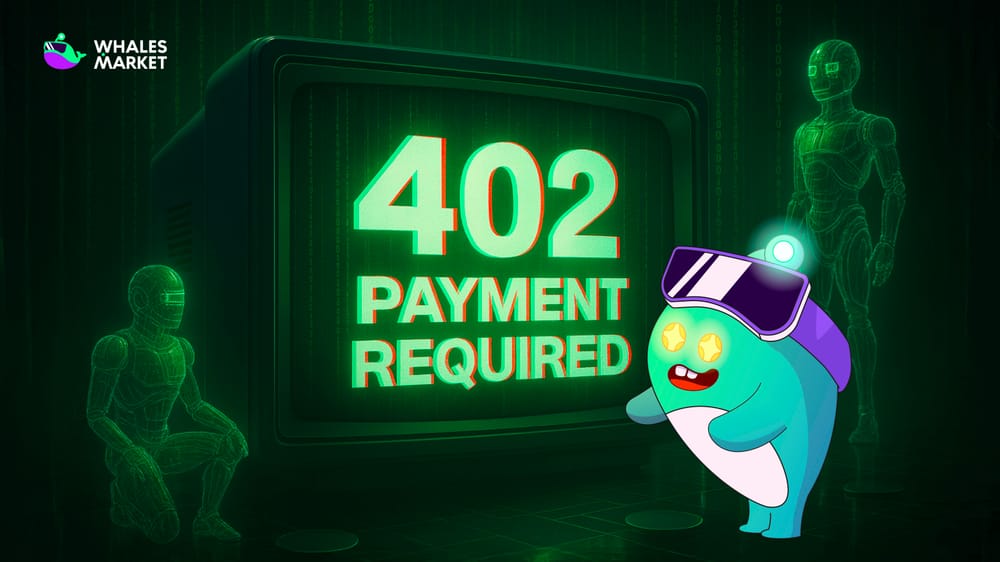
The process begins when an AI agent calls an API. Instead of returning data or a standard error, the server responds with a 402 status code. This response includes a payload with the price, accepted currency, and specific payment instructions required to access the service.
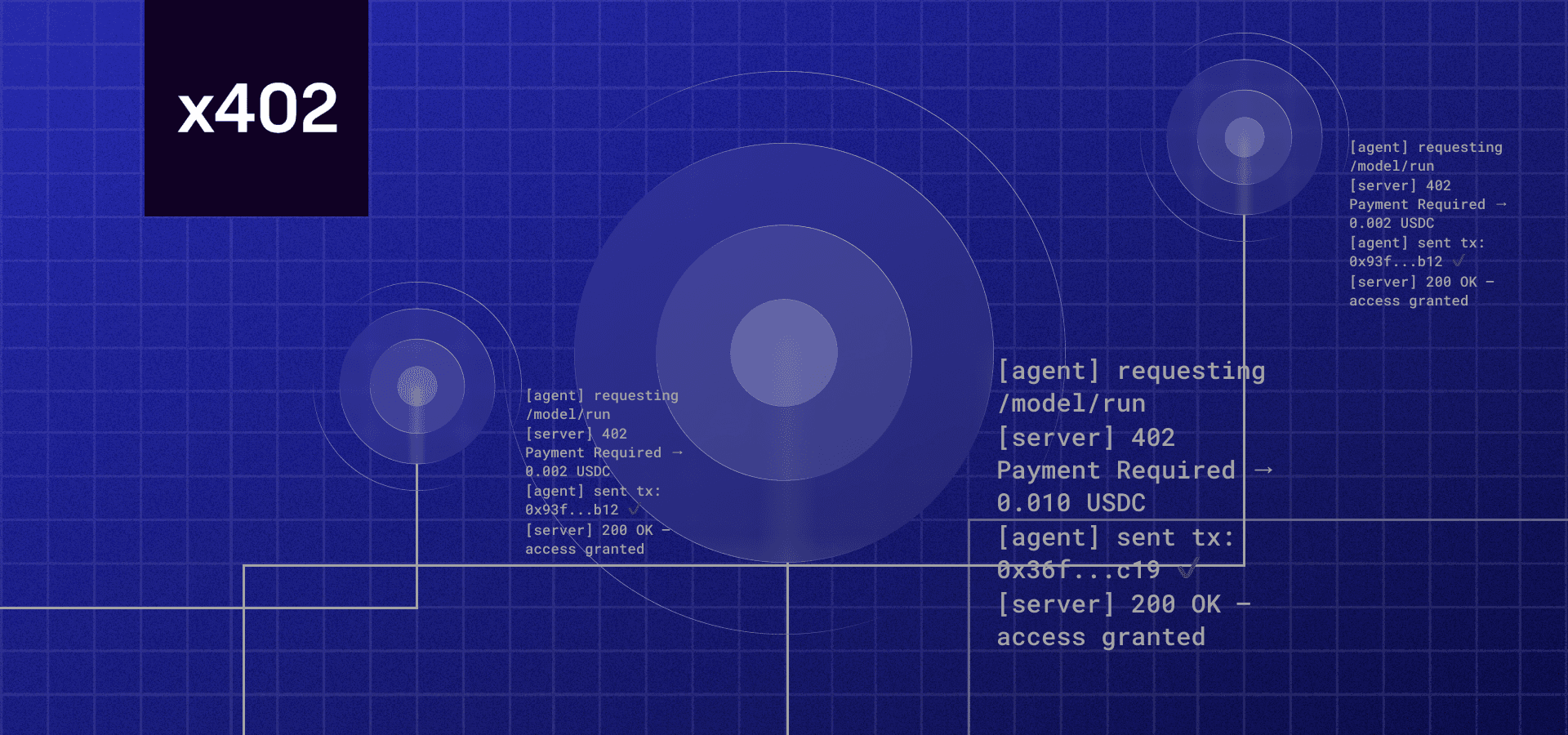
The agent’s local wallet parses the 402 payload to determine the cost. For micro-transactions common in AI inference, the median cost is approximately $0.02. The agent prepares a transaction using a supported stablecoin, typically USDC, to ensure predictable pricing and low volatility for both parties.
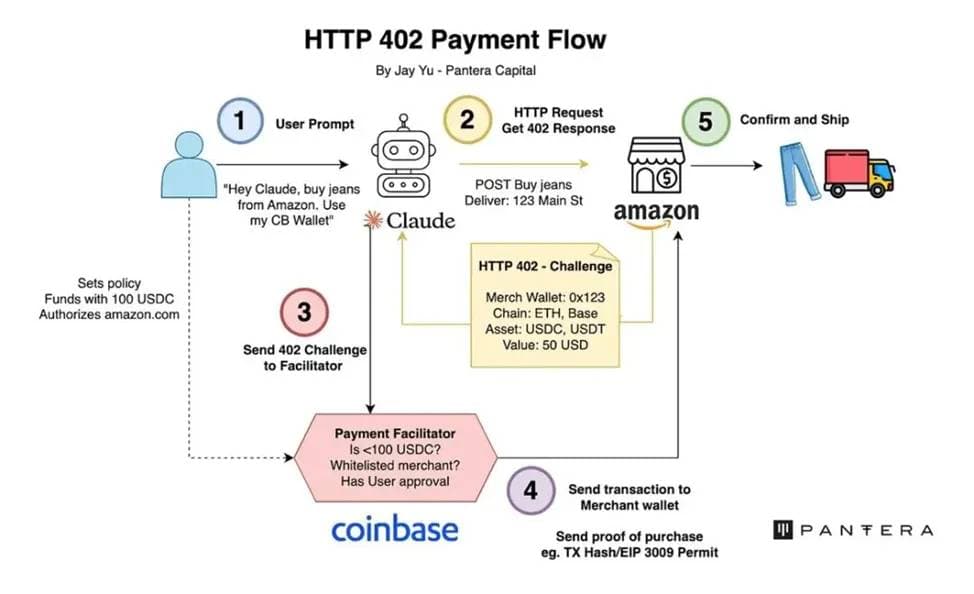
The agent signs and broadcasts the payment transaction to the blockchain. Once the smart contract confirms the transfer, the agent presents the transaction hash or signed receipt back to the API server. The server verifies the onchain confirmation and releases the requested data or computation result.
This flow transforms the internet into a direct-value network. By embedding payment logic into the HTTP protocol, x402 allows AI agents to autonomously purchase compute, data, and tools without human intervention, scaling the economy of digital services.
Comparing x402, AP2, and L402
By 2026, the agentic economy has settled into three dominant payment protocols, each solving a different layer of the machine-to-machine trust problem. Developers choosing a stack must decide whether to prioritize native web integration, enterprise scale, or micro-transaction efficiency.
x402 remains the standard for HTTP-native services. By turning the HTTP 402 status code into a machine-readable payment signal, it allows AI agents to pay for web resources without leaving the standard web stack. This makes it ideal for API access, content unlocking, and server-to-server interactions where maintaining HTTP compatibility is non-negotiable. The median cost for these transactions sits near $0.02, balancing speed with sufficient on-chain settlement.
Google’s Agent Payment Protocol (AP2) targets the enterprise and cloud infrastructure layer. Designed for high-volume, low-latency transactions within Google’s ecosystem, AP2 leverages existing identity and billing infrastructures. It is less about micropayments and more about scalable, authenticated service consumption for large-scale AI workloads.
L402, built on the Lightning Network, is the specialist for sub-cent transactions. It uses Bitcoin’s Lightning layer to enable near-instant, near-zero-fee payments. This makes it the only viable option for high-frequency, low-value tasks like paying for individual keystrokes, real-time data feeds, or micro-compute units where traditional blockchain fees would exceed the service cost.
The choice between these protocols often comes down to the unit economics of the AI agent’s workflow. If the agent is consuming expensive, high-value data or API calls, x402 provides the necessary web-native integration. If the agent is performing massive-scale, repetitive tasks within a cloud environment, AP2 offers the most robust enterprise support. For agents that need to pay for tiny, high-frequency actions, L402 is the only protocol that doesn’t bleed value through transaction fees.
The Economics of the Agentic Economy
As AI agents move from experimental prototypes to production workloads, the cost of machine-to-machine communication becomes a primary constraint. Under the x402 protocol, these interactions are no longer abstract API calls but micropayments that must be economically viable at scale. The market has already settled on a baseline price that makes high-frequency agent coordination feasible.
According to industry analysis from The AI Career Lab, the median price for an x402 endpoint with a visible price tag is just two cents per call as of July 2026. This low barrier to entry is what enables the "agentic economy" to function, allowing agents to perform thousands of micro-transactions without exhausting budgets. If the cost per call were higher, the overhead would outweigh the utility for most automated workflows.
This pricing structure supports several practical use cases:
- Agentic Workflows: Agents can independently verify data, fetch real-time information, or trigger external services by paying small fees directly. The $0.02 median ensures that a chain of five agent-to-agent handoffs costs less than a single cent.
- Data Marketplaces: Specialized AI models or datasets can be monetized directly. A developer can build an agent that pays $0.02 to query a niche data endpoint, creating a frictionless market for specialized information.
- Automated Services: Simple utility checks, such as verifying a blockchain transaction or fetching a weather update, can be handled autonomously. The low cost removes the need for complex billing systems or subscription models for these discrete tasks.
The economic reality of x402 Pay is that it turns computation into a commodity. By standardizing the payment layer, it allows developers to focus on the logic of their agents rather than the mechanics of billing. As the network matures, we expect these median costs to remain stable or decrease, further accelerating the adoption of autonomous economic agents.
Implementing x402 in Your Stack
Integrating x402-compatible flows does not require replacing your existing infrastructure. Instead, it leverages the same HTTP mechanics and API gateways you already use, turning standard endpoints into machine-readable payment channels. In early 2026, major infrastructure providers like Coinbase and Cloudflare began supporting this protocol, enabling AI agents to settle micro-payments in stablecoins without complex wallet management.
The integration primarily involves configuring your API gateway to recognize the 402 Payment Required status code. When an AI agent requests a resource, the gateway checks for valid payment credentials. If the payment is missing or insufficient, the server returns a 402 response with the necessary payment instructions. Once the agent pays, access is granted instantly. This flow reduces the median cost of machine-to-machine transactions to approximately $0.02, making it economically viable for high-frequency agent interactions.
To get started, developers should focus on the authentication layer. Most implementations wrap standard REST or GraphQL endpoints with a middleware that handles crypto verification. This approach ensures that legacy systems can participate in the agentic economy without a complete rebuild. The key is ensuring your payment processor can handle the volume of small, automated transactions efficiently.
Common Questions About x402
Developers and fintech teams often ask how x402 compares to traditional payment infrastructure. The core difference is that x402 is designed for machine-to-machine interactions in the agentic economy, not human checkout flows. It removes the friction of manual authorization by embedding payment logic directly into HTTP responses.
Is x402 secure for high-value transactions?
Security in x402 relies on the underlying blockchain network and the cryptographic verification of the 402 Payment Required response. Unlike traditional gateways that store card details, x402 transactions are on-chain or settled via stablecoins, reducing the attack surface for data breaches. Agents verify the proof of payment before granting access to the API resource.
How does latency compare to Stripe?
x402 transactions can be faster than traditional credit card processing for micro-payments. While Stripe may take seconds to clear and settle, x402 leverages low-latency stablecoin networks. The median cost for these transactions is approximately $0.02, making it economically viable for AI agents to pay for small computational tasks in real-time.
Can x402 work with existing payment gateways?
Not directly. x402 is a protocol, not a merchant account. It does not integrate with Stripe or PayPal for on-chain settlements. Instead, it acts as the transport layer for machine-to-machine commerce. Traditional gateways handle human-led commerce; x402 handles the agentic economy where bots negotiate and pay for services autonomously.
No comments yet. Be the first to share your thoughts!